This semester at Eng102 class was a very enjoyable experience for me. I had the most fun than any other previous English class I had experienced here at La Guardia. When I first sat down in class for the first time I had thought what type of writing us (students) were expected to do. Learning it was the "Super Natural" theme, I found it very exciting because themes like Greek Mythology, Angels and Demons, Vampires and Werewolves were fun topics I could talk freely about in my writing. I then thought of my youngest sister who is currently a high school freshman at Long Island City High School. She loves to read books such as the Harry Potter series and is a huge fan of the Super Natural. I would recommend this class to her if she ever considers to take an English class here at La Guardia. Talking back about me again, my first blog opened the door of myself that connected me with the other students. I then read from other students and learned that each introduction was a different story. Reading from their first blogs, I learned a little bit about their personalities through their writing style.
My second blog started the real work in class; I had to choose a poem of my own choice and the first thing that had popped into my mind was Greek mythology. I wanted to find a poem that would talk or relate to the heroes, gods and goddesses that were so famous and exciting to read about. I chose Ares because he was the type of god who would always have his way of doing things and he loved to partake in battles for senseless fun and I thought that was cool. The other reason was that there was a popular video game that is still popular in the series. That game is “God of War” and playing that game for the first time was an insane experience. It was brutal, gory and it did bring me fear seeing how I slaughtered mythologcial monsters but as I continued on the game grew on me and I saw myself being the hero on a very important quest. Which then brings up to my next fun experience that I had learned in this class called the 'Hero's Quest'.
The other theme we worked on in class that was really interesting to me was the Hero's Quest. In class we had watched an animated film, by the famous Japanese director Hayao Miyazaki, called 'Spirited Away'. I actually very much enjoy Japanese anime culture and famous action hero films that exist in Japan. For our own choice in choosing a hero’s quest film, I had chosen to write about a heroic Japanese film called “Azumi”. She is the lone female assassin that actually survives all the trials and challenges that her fellow male assassins could not. She is the unlikely sexy heroine that would take on an entire army of soldiers and bandits in order to save japan from another war that has brought devastation upon many people. Using 'Monomyth' or the 'Hero's Journey' helped me to analyze the film by seeing the story into specific stages that lead to the hero surpassing or transcending his/ her former self. Learning this helped me to analyze heroic films even differently than i had seen them before.
For one of the last few blogs i had worked on the end of the semester was a short story called the "Tell Tale Heart". In this Engish class, I had also learned topics related to the field of Psychology and before I thought that studying the field would make a person go crazy but I see now that the topic is indeed very interesting. we learned about the Carl Jung's 'Shadow' and Sigmund Freud's 'Psychoanalytical Criticism'. Working on my short story has piqued my interest to learn more about psychology and what goes on inside the mind of people that are suffering mentally. Back again to my short story, Using psychoanalysis helped me to get some kind of psychological ideas that perhaps drove the narrator to go insane such as him denying that he is a mad crazy person. He is in self denial. The fact that he can be able to tell a story openly to his audience through the story and being able to describe every action is indeed quite insane. I think I will consider to study psychology since it seems to me a very interesting topic to learn from seeing that it is also still a new field to science.
My overall experience here in this class was indeed fun and i had met many interesting people that came with their own ideas.
Monday, June 14, 2010

Wednesday, June 2, 2010
Blog 15: Final Draft

The author of the short story Edgar Allan Poe, was born on January 19, 1809 and died on October 7, 1849. His parents had died when he was very young, thus he became an orphan, but was later adopted into the Allan family by John and Frances Allan. Poe was an American writer, poet, and journalist; he is considered to be a member and part of the American Romantic movement. He had struggled financially and had earned his living by writing essays and short stories from which he earned very little. Poe died from unknown causes due to brain congestion, drugs, alcohol, heart disease, suicide, and other unknown factors that could've led to his death. His early experiences with death and the passing of many close people to him may be the result of his own psyche going insane.
In "The Tell-Tale Heart" the story is told by an unknown narrator. He is actually the Protagonist and the Antagonist in this story. To further explain this, he is both the victim and the predator of his own actions. He plots to kill the Old Man being the predator and becomes the victim of guilt when he hears the sound of his own heart beat. Perhaps an even better interpretation is that the narrator is his own worst enemy in the sense that he is always having conflicts within himself. At first, in the beginning of the tale, he claims that he harbors no ill will towards the Old Man and he is always kind to him. The only thing that disturbed him was the "Vulture eye" the Old Man possessed. The narrator states, “Whenever it fell upon me, my blood ran cold; and so by degrees – very gradually – I made up my mind to take the life of the old man, and thus rid myself of the eye forever.” This can explain the inner feelings of loath and disturbed hate he had for the Old Man.
Much earlier in the opening of the story, the narrator claims that he is indeed very nervous but not does not consider himself to be mad but only having sharp "Acute" senses because of "The disease". This disease he speaks of is probably a disorder known as Neurosis. "Neurosis is a class of functional mental disorders involving distress but neither delusions nor hallucinations, whereby behavior is not outside socially acceptable norms. This disorder is also known as psychoneurosis or neurotic disorder" (Wikipedia). The narrator seems to be suffering from this severe disease yet claims that it has made him aware of all things.
After eight consecutive nights, the narraor calmly waits in the darkness... like a shadow stalking the Old Man in his sleep. Waiting for the opportunity to murder him but ultimately to eliminate his eye. When he succeeds and murders the Old Man, he disposes the body by dismembering the corpse and hides it underneath a wooden plank. He finally feels that all is well and solved. He does not regret or even consider the event that just happened then policemen arrive for an inspection. The narrator gladly welcomes the policemen and displays his confidence yet after their long stay he suddenly becomes paranoid because he hears the sound of a beating heart. The noise haunts him as the sound gets louder and louder until he is no longer able to contain his guilt and at last confesses to the policemen by revealing all that has really happened and that he was actually the murderer.
The field of Psychology was established by an Austrian psychoanalyst named Sigmund Freud; he is the founding father of the field and has written many theories concerning the functions and thoughts of a person’s psyche. According to Wikipedia, "Psychoanalytic Literary Criticism is the literary approach where critics see the text as if it were a dream. The process of changing from latent to manifest content is known as the dream work" (Wikipedia). The hidden message in the text lies latent and it is the critic’s job to unravel the mystery by identifying the symbolism and language used in arriving at the true content.
The article Unconscious Mind, "While past thoughts and memories may be deleted from immediate consciousness, they direct the thoughts and feelings of the individual from the realm of the unconscious". This quote explains the narrator's unconscious feelings towards the old man himself because he was driven to the limit of going mad that because of the old man's eye he had decided that he should be put to death.
One of the main symbols appearing in this story is the "Vulture Eye", The narrator explains how it deeply disturbs him as he gazes upon it and that it is a sight that makes his blood run cold. According to a website enotes.com, the vulture eye symbolizes the coming of death. The vulture is a huge flying bird and is the predator circling around a sickly animal or persons waiting until it dies so that it can consume the corpse. Therefore, the Old Man was nearing his death as he was watched from behind the shadows. Many other symbols appearing in the story are shadow, death, corpse, and heart. In Shadow Psychology from Wikipedia, "The shadow is a part of the unconscious mind consisting of repressed weaknesses, shortcomings, and instincts". This in general can explain the person's most personal and inner feelings and our strong feelings usually cannot be openly expressed. However in the dream world, all feelings and strong desires can be fulfilled and expressed beyond the ordinary limits in the real world. One of the most well known psychologists, Carl Jung, notes that "the shadow sometimes overwhelms a person's actions; for example, when the conscious mind is shocked, confused, or paralyzed by indecision".
Works Cited
Holman and Snyder. “Edgar Allan Poe” About.com. web. 25 May 2010Poe, Edgar. “The Tell-Tale Heart” PoeStories.com. web. 25 May 2010
“Psychoanalytic Literary Criticism” Wikipedia. 29 March 2010. web. 25 May 2010
“Shadow (Psychology)” Wikipedia. 20 May 2010. Web. 25 May 2010
Image Link: http://ckim112689.files.wordpress.com/2007/05/45850529_d2a10ad7ce.jpg
Blog 14: Stronger revision on blog 13
I believe that I must put more focus into the interpretation of symbols using psychoanalysis instead of just what the general meaning for it could be in the online dictionary of symbolism. I think using other related topics such as shadow psychology and neurosis will help further develop my essay.
Tuesday, May 25, 2010
Blog 13 : Full Draft
The author of the short story Edgar Allan Poe, was born on January 19, 1809 and died on October 7, 1849. His parents had died when he was very young, thus he became an orphan but was later adopted into the Allan family by John and Frances Allan. Poe was an American writer, poet, and journalist; he is considered to be part of the American Romantic movement. He had struggled all his life financially and had earned his living by writing essays and short stories which had earned him very little. Poe died from unknown circumstances due to brain congestion, drugs, alcohol, heart disease, suicide, and the list goes on. His experiences with the deaths of many close people to him may be the result of his own psyche going insane.
In The Tell-Tale Heart the story is told by an unknown narrator. He is actually the Protagonist and the Antagonist in this story. To further explain this, he is both the victim and the predator of his own actions. He plots to kill the Old Man being the predator and becomes the victim of guilt when he hears the sound of heart beating . At first in the beginning of the tale, he claims that he harbors no ill will towards the Old Man and he is always kind to him. The only thing that disturbed him was the "Vulture eye" the Old Man possessed. The narrator states, “Whenever it fell upon me, my blood ran cold; and so by degrees – very gradually – I made up my mind to take the life of the old man, and thus rid myself of the eye forever.” This can explain the inner feelings of loath and disturbed hate he had for the Old Man.
Much earlier in the opening of the story, he claims that he is indeed very nervous but not does not consider himself to be mad only having sharp "Acute" senses because of "The disease". This disease he speaks of is a disorder known as Neurosis. Neurosis is a class of functional mental disorders involving distress but neither delusions nor hallucinations, whereby behavior is not outside socially acceptable norms. This disorder is also known as psychoneurosis or neurotic disorder (Wikipedia). The narrator seems to be suffering from this severe disease yet claims that it has made him aware of all things.
After 8 consecutive nights, silently he still waits like a shadow looking over the Old Man in his sleep. Waiting for the opportunity to murder him but ultimately to eliminate his eye. When he succeeds and murders the Old Man, he disposes the body by dismembering the corpse and hides it underneath a wooden plank. He finally feels that all is well and solved. He does not regret or even consider the event that just happened then policemen arrive for an inspection. The narrator gladly welcomes the policemen and displays his confidence yet after their long stay he suddenly becomes paranoid because he hears the sound of a beating heart. The noise haunts him as the sound gets louder and louder until he is no longer able to contain his guilt and at last confesses to the policemen by revealing all that has really happened and that he was actually the murderer.
The field of Psychology was established by an Austrian psychoanalyst named Sigmund Freud; he is the founding father of the field and has written many theories concerning the functions and thoughts of a person’s psyche. According to Wikipedia, Psychoanalytic Literary Criticism is the literary approach where critics see the text as if it were a kind of dream. The hidden message in the text lies latent and it is the critic’s job to unravel the mystery by identifying the symbolism and the language used and arrives at the true meaning.
In Psychoanalytic Criticism, this specific literary approach is how critics interpret literature as dreams. The text represses its real or latent content behind obvious content (Wikipedia), therefore in dreams they can be expressed as some sort of outlet to lessen the actual reality that occurs in the real world itself. The process of changing from latent to manifest content is known as the dream work (Wikipedia). In the article Unconscious Mind, "While past thoughts and memories may be deleted from immediate consciousness, they direct the thoughts and feelings of the individual from the realm of the unconscious". This quote may be able to explain the narrator's unconscious feelings towards the old man himself because he was driven to the limit of going mad that because of the old man's eye he had decided that he should be put to death.
One of the main symbols appearing in this story is the "Vulture Eye", the narrator explains how it deeply disturbs him as he gazes upon it and that it is a sight that makes his blood run cold. According to a website enotes.com, the vulture eye symbolizes the coming of death. The vulture is a huge flying bird and is the predator circling around a sickly animal or person waiting until it dies so that it can consume the corpse. Therefore, the Old Man was nearing death as he was soon to fall victim before the narrator. Many other symbols appearing in the story are shadow, death, corpse, and heart. In Shadow Psychology from Wikipedia, the shadow is a part of the unconscious mind consisting of repressed weaknesses, shortcomings, and instincts. This in general can explain the person's most personal and inner feelings and our strong feelings usually cannot be openly expressed, however in the dream world, all feelings and strong desires can be fulfilled and expressed beyond the ordinary limits in the real world. One of the most well known psychologists, Carl Jung, notes that "the shadow sometimes overwhelms a person's actions; for example, when the conscious mind is shocked, confused, or paralyzed by indecision".
Works Cited:
Holman and Snyder. “Edgar Allan Poe” About.com. web. 25 May 2010
Poe, Edgar. “The Tell-Tale Heart” PoeStories.com. web. 25 May 2010
“Psychoanalytic Literary Criticism” Wikipedia. 29 March 2010. web. 25 May 2010
“Shadow (Psychology)” Wikipedia. 20 May 2010. Web. 25 May 2010
Monday, May 17, 2010
Blog 12: Initial pre-writing
The Tell-Tale Heart
The short story The Tell-Tale Heart by Edgar Allan Poe, is a short horror story first published in January of 1983. This short story is one of the most familair stories I have read from Edgar Allan Poe's collection of short horror stories since middle school. From start to finish I find that it is chilling and disturbing how the story unfolds from sanity to the insanity of the narrator's mind. For my analysis and interpertation of the story I will use the Psychoanalytic Literary Criticism to further explain the events, thoughts, and the possibilites of interpreting the narrator's mind. With that said, the story is narrated by the unreliable narrator (himself), who explains the events of how he carefully calculates the murder of the old man who possess an evil eye he calls " The Vulture Eye".
According to the narrator himself, he claims in the beginning that he is very nervous but not mad because if he were he would be unable to tell his story to us (the audience). The narrator waits silenty like a shadow as the old man sleeps looking for an open opportunity to murder him but ultimately his eye. After the murder he disposes of the body by dismembering the corpse and hiding it underneath a wooden plank. He feels that all is well and solved but his confidence dissipates as the policemen come for an inspection after their long stay at the narrator's house. The narrator switches from his confidence and then becomes paranoid because he hears the sound of a beating heart. The noise haunts him as the sound gets louder and louder until he is no longer able to contain his guilt and at last confesses to the policemen by revealing all that has really happened and that he was actually the murderer.
One of the main symbols appearing in this story is the "Vulture Eye", the narrator explains how it deeply disturbs him as he gazes upon it and that it is a sight that makes his blood run cold. According to a website enotes.com, the vulture eye symbolizes the coming of death. The vulture is a huge flying bird and is the predator circling around a sickly animal or person waiting until it dies so that it can consume the corpse. Therefore, the Old Man was nearing death as he was soon to fall victim before the narrator. Many other symbols appearing in the story are shadow, death, corpse, and heart. In Shadow Psychology from wikipedia, the shadow is a part of the unconscious mind consisting of repressed weaknesses, shortcomings,and instincts. This in general can explain the person's most personal and inner feelings and our strong feelings usually cannot be openly expressed, however in the dream world, all feelings and strong desires can be fulfilled and expressed beyond the ordinary limits in the real world. One of the most well known psychologists, Carl Jung, notes that "the shadow sometimes overwhelms a person's actions; for example, when the conscious mind is shocked, confused, or paralyzed by indecision". When the narrator found the Old Man's eye open as he slept he all of a sudden lept and suffocated him to death.
In the analysis of Psychoanalytic Literary Criticsm, this literary approach is how critics interpret literature as dreams.The text in literature is actually hiding its true content or desires, therefore in dreams they can be expressed as some sort of outloet to lessen the actual reality that occurs in the real world itself. From the wikipedia in the article Unconscious Mind, "While past thoughts and memories may be deleted from immediate consciousness, they direct the thoughts and feelings of the individual from the realm of the unconscious". This quote may be able to explain the narrator's unconscious feelings towards the old man himself because he was driven to the limit of going mad that because of the old man's eye he had decided that he should be put to death.
Links:
http://en.wikipedia.org/wiki/Unconscious_mind
http://en.wikipedia.org/wiki/Psychoanalytic_criticism
http://en.wikipedia.org/wiki/Shadow_(psychology)
http://en.wikipedia.org/wiki/The_Tell-Tale_Heart
http://www.enotes.com/tell-tale-heart/q-and-a/what-might-vultures-eye-symbolize-59725
The short story The Tell-Tale Heart by Edgar Allan Poe, is a short horror story first published in January of 1983. This short story is one of the most familair stories I have read from Edgar Allan Poe's collection of short horror stories since middle school. From start to finish I find that it is chilling and disturbing how the story unfolds from sanity to the insanity of the narrator's mind. For my analysis and interpertation of the story I will use the Psychoanalytic Literary Criticism to further explain the events, thoughts, and the possibilites of interpreting the narrator's mind. With that said, the story is narrated by the unreliable narrator (himself), who explains the events of how he carefully calculates the murder of the old man who possess an evil eye he calls " The Vulture Eye".
According to the narrator himself, he claims in the beginning that he is very nervous but not mad because if he were he would be unable to tell his story to us (the audience). The narrator waits silenty like a shadow as the old man sleeps looking for an open opportunity to murder him but ultimately his eye. After the murder he disposes of the body by dismembering the corpse and hiding it underneath a wooden plank. He feels that all is well and solved but his confidence dissipates as the policemen come for an inspection after their long stay at the narrator's house. The narrator switches from his confidence and then becomes paranoid because he hears the sound of a beating heart. The noise haunts him as the sound gets louder and louder until he is no longer able to contain his guilt and at last confesses to the policemen by revealing all that has really happened and that he was actually the murderer.
One of the main symbols appearing in this story is the "Vulture Eye", the narrator explains how it deeply disturbs him as he gazes upon it and that it is a sight that makes his blood run cold. According to a website enotes.com, the vulture eye symbolizes the coming of death. The vulture is a huge flying bird and is the predator circling around a sickly animal or person waiting until it dies so that it can consume the corpse. Therefore, the Old Man was nearing death as he was soon to fall victim before the narrator. Many other symbols appearing in the story are shadow, death, corpse, and heart. In Shadow Psychology from wikipedia, the shadow is a part of the unconscious mind consisting of repressed weaknesses, shortcomings,and instincts. This in general can explain the person's most personal and inner feelings and our strong feelings usually cannot be openly expressed, however in the dream world, all feelings and strong desires can be fulfilled and expressed beyond the ordinary limits in the real world. One of the most well known psychologists, Carl Jung, notes that "the shadow sometimes overwhelms a person's actions; for example, when the conscious mind is shocked, confused, or paralyzed by indecision". When the narrator found the Old Man's eye open as he slept he all of a sudden lept and suffocated him to death.
In the analysis of Psychoanalytic Literary Criticsm, this literary approach is how critics interpret literature as dreams.The text in literature is actually hiding its true content or desires, therefore in dreams they can be expressed as some sort of outloet to lessen the actual reality that occurs in the real world itself. From the wikipedia in the article Unconscious Mind, "While past thoughts and memories may be deleted from immediate consciousness, they direct the thoughts and feelings of the individual from the realm of the unconscious". This quote may be able to explain the narrator's unconscious feelings towards the old man himself because he was driven to the limit of going mad that because of the old man's eye he had decided that he should be put to death.
Links:
http://en.wikipedia.org/wiki/Unconscious_mind
http://en.wikipedia.org/wiki/Psychoanalytic_criticism
http://en.wikipedia.org/wiki/Shadow_(psychology)
http://en.wikipedia.org/wiki/The_Tell-Tale_Heart
http://www.enotes.com/tell-tale-heart/q-and-a/what-might-vultures-eye-symbolize-59725
Monday, May 10, 2010
Blog 11: My Chosen Story
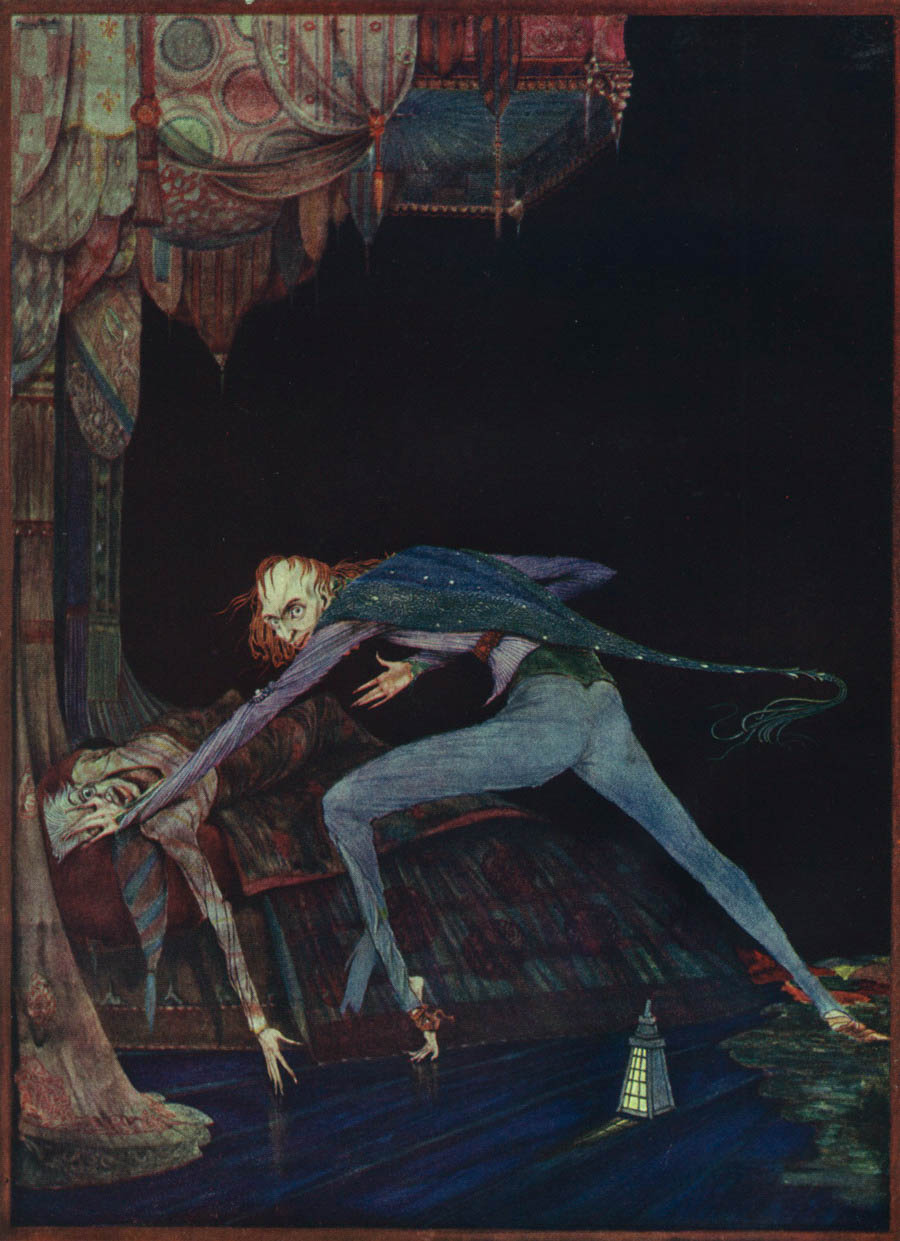
The Tell-Tale Heart by Edgar Allan Poe
For this assignment, I have chosen to do an analysis on the title: The Tell-Tale Heart by Edgar Allan Poe. I have chosen this short horror-fiction story because I am familiar with reading the story before and the story itself really gives off creepy and eerie feelings while reading it. The basic plot of the story tells of a man (the narrator) who goes insane after murdering an old man with a vulture eye. He hides the dead body under the floor boards and as time passes he becomes paranoid and in his thought he is haunted by the sound of heartbeating where he has hidden the old man. In my interpretation, the story itself is disturbing in how the narrator describes his thoughts and actions of how he carefully plans the murder of the old man. For the specific approach, I will use psychoanalytic criticism to further analyze the narrator's thoughts of how he may have felt when encountering the old man and perhaps his subconscious played the significant role which led him to kill the old man. According to the wikipedia, psychoanalytic criticism can yied useful clues to the sometime baffling symbols, actions, and settings in a literary work. In addition to that, this literary approach is where critics see the text as if it were a kind of dream. This approach may be able to help me in understanding what goes in the narrator's mind and why he feels guilt towards his actions in the end.
External Links:
http://en.wikipedia.org/wiki/The_Tell-Tale_Heart
http://poestories.com/read/telltaleheart
http://en.wikipedia.org/wiki/Psychoanalytic_criticism
Image link:
http://upload.wikimedia.org/wikipedia/commons/4/43/Clarke-TellTaleHeart.jpeg
Tuesday, May 4, 2010
Blog 10: Reflection

Image Link: http://images.fanpop.com/images/image_uploads/Drakengard-2-drakengard-798973_1024_768.jpg
Sunday, May 2, 2010
Blog Entry 9 Hero's Quest Film
Azumi: The Ultimate Female Assassin

In the beginning stage of the hero's journey, Departure, Azumi and her 9 comrades had completed their daily training in the woods. One day during a meal gathering their master informs the group that they will soon leave the mountain to start their first mission. The next morning, they are given a final test by master Gessai. This test is a crucial test that will determine which assassins will be able to become successful in completing their missions. As ordered by Gessai, everyone pairs up with a teammate they are comfortable with or deeply bonded to. The master then speaks to his apprentices saying, "an assassin is unable to choose whom to kill... the way of the assassin is to have a mind of steel and become inhuman. Thus, I give you this final test. Slay each other, slay your teammate, kill!" This is the first stage of departure where they must kill their fellow teammate and survive to complete the mission they were trained for since childhood. Azumi is paired with her close partner, Nachi. She hesitates to kill Nachi thus, she refuses the call. When Nachi decides to accept his destiny Azumi sees his determination and she is forced to accept the call killing him. As Nachi is dying, he presents to Azumi his talisman of charm. Which according to him will help guide her in her quest. In the second part of the departure, the 5 remaining assassins stand in front of the graves of their fallen friends and comrades, they burn down their hut, and officially leave the mountain with their master. This is where they begin to leave the known realm and into the unknown. (from left to right bottom picture: Nagara, Amagi, Hyuga, Azumi, and Ukiha.)

In the next stage, Initiation, the group leaves the mountain and encounter a nearby village only to witness the slaughtering of local villagers by bandits. Azumi, her friends and their master witness this event and soon the group becomes infuriated yet eager to help the people. However, Gessai forbids them to take action and are forced to become spectators of a massacre. The simple reason Gessai gave to his apprentices is that helping them is not directly involved with their mission therefore, becoming involved in something small will not improve the nation itself. This was the initiation of reality the master had his apprentices experience as young assassins. Soon after the event, they cross and pass through the first threshold only to be surprised by another fellow assassin named Nagato. Nagato is a master ninja sent by priest Tenkai, who had assigned the samurai Gessai in the task of raising a band of assassins. This meeting was held during the aftermath of Sekigahara as they both stood before the fallen bodies of allied soldiers. Jumping back to the present, Nagato holds a letter out to Gessai; this letter contains the names of the three warlords they must eliminate and their goal or primary objective. These foes are, Nagamasa Asano, Kiyomasa Kato, and Masayuki Sanada; all of the named warlords pose a threat to the Tokugawa government yet their goal is to begin a new war in reclaiming the power of Shogun and appointing it to their ruler Toyotomi Hideyori; son and heir of Toyotomi Hideyoshi.
In the road of trials, the team immediately begins their assigned task. Azumi confronts a band of samurai one morning out fishing by the sea; the other assassins hide and watch from behind the bushes. Azumi talks to an elder member of the samurai group who is fascinated by her beautiful appearance. She questions him and asks what he is doing; he goes on talking about the enjoyment of fishing. Azumi sees him struggling and then lectures him on how to catch fish. After forcefully throwing a small stone into the water, a great number of fish are soon caught. He is impressed at her skill in the sport and both formally introduce each other. Yet, when she learns his name she realizes that he is one of the targets she is assigned to eliminate; Nagamasa Asano. Her comrades sneak and attack the guards from behind and Azumi herself is left to assassinate the man whom she must eliminate. From this point out, the other warlord Kiyomasa Kato is the only warlord concerned in the entire film. As soon as Kiyomasa learns of Nagamasa's death he takes careful precaution and hires deadly mercenaries standing in the way of Azumi and her group. (Bottom picture from left to right: Azumi vs. Bijoumaru Mogami.)

The final stage of Return, after Azumi is disowned by her master and is no longer an assassin, she tries to live the life of an ordinary Japanese woman in the era of Tokugawa. Yet, she soon realizes no matter where she runs she cannot hide from the fact that seeing more bloodshed happening will not easily pass and will continue until she can make a great change happen. With determination she goes to the castle of Kiyomasa Kato to go face him yet stands before hundreds of his warriors. She also goes to rescue the surviving assassins and her master. Unfortunately, most of Azumi's comrades had already been slain by mercenaries and bandit groups. The final and great battle of the film was against the insane narcissistic killing swordsman named Bijoumaru. Instead of having a female temptress like many other films, here Bijoumaru is a man who represents that role; his literal name translates to "beautiful man". After Azumi triumphs from battle, she sadly witnessess the passing of her own master which was the father figure who had raised her. What Azumi understands to be her own true mission in life is creating peace and doing everything in her power to prevent a civil war happening in Japan. From the film perspective, she has transcended above being just a tool for assassination, she has devoted herself along with her lone comrade survivor, Nagara, as protectors and guardians of the people suffering during this era. Near the end of the film, Kiyomasa is confident about his escape yet Azumi surprises to show herself and cuts swiftly upon him. One of Kiyomasa's subordinates, Kanbei, rushes over witnessing the flame of life leaving his master. Azumi finally ends in the a sunset scene where only two surviving assassins remain to fulfill the final assassination of the last warlord, Masayuki Sanada.
Image Links
http://www.asianfilmclub.com/wp-content/uploads/2009/10/azumi1.jpghttp://thecia.com.au/reviews/a/images/azumi-8.jpg
http://www.smh.com.au/ffximage/2004/11/03/azumi_wideweb__430x342.jpg
Works Cited
Azumi. Imdb.com. 2007. Web. April 30, 2010Azumi. Mysoju.com. 2007. Web. April 30. 2010.
Battle of Sekigahara. Wikipedia. 2010. Web. April 30, 2010.
Tokugawa Ieyasu. Wikipedia. 2010. Web. April 30, 2010.
Thursday, April 22, 2010
Blog 8
“Ulysses and Calypso” by Edward Robeson Taylor
For that they slew the cattle of the Sun
Ulysses' comrades sank to death while he,
Borne on the billows of the friendly sea,
Calypso's lovely isle in safety won;
Where filled with soothing rest his days did run
To murmurous music's luring notes as she
Bound him in coils of such captivity,
That but for Zeus his soul had been undone.
The God's decree the enamored nymph obeyed,
And helped the hero as his raft he made,
While brimmed her heart with desolation's tears.
His glimmering sail she watched till in the sea's
Great void 'twas lost, then moaned because her years
Were not as mortal as Penelope's.
Edward Robeson Taylor was born on September 24, 1838 in Springfield, Illinois. He was the only son of Henry West Taylor and Mary Thaw of Philadelphia, Pennsylvania. He was the 28th Mayor of San Francisco serving from July 16th, 1907 to January 7th, 1910. Before his office in mayor, he was a lawyer, physician, and a poet in California. Taylor died in San Francisco, California on July 5, 1923.
The poem is consisted of 14 lines and a single stanza. The rhyme scheme of the first 6 lines in the poem can be interpreted as ABBAAB; from lines 7 and 8 there are no connections in the rhyme scheme of the poem so it is CD. Throughout lines 9 to 14 the rhyme is read as EEFGFG.
“Ulysses and Calypso” is actually about the mythological story of Ulysses’ journey home to his kingdom in Ithaca. He is washed ashore on Calypso’s island after his ship was destroyed by a thunderbolt and becomes the sole survivor of his crew. Ulysses' comrades sank to death while he (line 3) Borne on the billows of the friendly sea (line 4) Calypso's lovely isle in safety won (line 5). When Ulysses is in the island he The voice in this poem belongs to the narrator or the author himself, Edward Robeson Taylor. The story itself and the events of Ulysses being held captive at Calypso’s island are told in this poem.
The symbols shown in the poem are sun, death, sea, zeus, soul, god, nymph, hero, heart, great void, and mortal. The sun is according to the Dictionary of Symbolism, “the absolute cosmic power; it represents knowledge, warmth, glory, and splendor.” Death is internationally associated with pain, sorrow, grief, despair, darkness, and the end of life. The sea is symbolic for being the “known quantities of life”, according to the Dictionary of Symbolism.
Works Cited Sources:
"Edward Robeson Taylor." Wikipedia.org Web. January 26, 2010. April 19, 2010.
"Edward Robeson Taylor." Freebase.com Web. November13, 2008. April 19, 2010.
Hunter, James. "Odysseus." Pantheon.org Web. March 3, 1997. April 19, 2010.
Dictionary of Symbolism. University of Michigan Fantasy and Science Fiction Website. 2001. Web. April 19, 2010.
Taylor, Robeson Edward. "Ulysses and Calypso." BlackCatPoems.com Web. 2007. April 19, 2010.
For that they slew the cattle of the Sun
Ulysses' comrades sank to death while he,
Borne on the billows of the friendly sea,
Calypso's lovely isle in safety won;
Where filled with soothing rest his days did run
To murmurous music's luring notes as she
Bound him in coils of such captivity,
That but for Zeus his soul had been undone.
The God's decree the enamored nymph obeyed,
And helped the hero as his raft he made,
While brimmed her heart with desolation's tears.
His glimmering sail she watched till in the sea's
Great void 'twas lost, then moaned because her years
Were not as mortal as Penelope's.
Edward Robeson Taylor was born on September 24, 1838 in Springfield, Illinois. He was the only son of Henry West Taylor and Mary Thaw of Philadelphia, Pennsylvania. He was the 28th Mayor of San Francisco serving from July 16th, 1907 to January 7th, 1910. Before his office in mayor, he was a lawyer, physician, and a poet in California. Taylor died in San Francisco, California on July 5, 1923.
The poem is consisted of 14 lines and a single stanza. The rhyme scheme of the first 6 lines in the poem can be interpreted as ABBAAB; from lines 7 and 8 there are no connections in the rhyme scheme of the poem so it is CD. Throughout lines 9 to 14 the rhyme is read as EEFGFG.
“Ulysses and Calypso” is actually about the mythological story of Ulysses’ journey home to his kingdom in Ithaca. He is washed ashore on Calypso’s island after his ship was destroyed by a thunderbolt and becomes the sole survivor of his crew. Ulysses' comrades sank to death while he (line 3) Borne on the billows of the friendly sea (line 4) Calypso's lovely isle in safety won (line 5). When Ulysses is in the island he The voice in this poem belongs to the narrator or the author himself, Edward Robeson Taylor. The story itself and the events of Ulysses being held captive at Calypso’s island are told in this poem.
The symbols shown in the poem are sun, death, sea, zeus, soul, god, nymph, hero, heart, great void, and mortal. The sun is according to the Dictionary of Symbolism, “the absolute cosmic power; it represents knowledge, warmth, glory, and splendor.” Death is internationally associated with pain, sorrow, grief, despair, darkness, and the end of life. The sea is symbolic for being the “known quantities of life”, according to the Dictionary of Symbolism.
Works Cited Sources:
"Edward Robeson Taylor." Wikipedia.org Web. January 26, 2010. April 19, 2010.
"Edward Robeson Taylor." Freebase.com Web. November13, 2008. April 19, 2010.
Hunter, James. "Odysseus." Pantheon.org Web. March 3, 1997. April 19, 2010.
Dictionary of Symbolism. University of Michigan Fantasy and Science Fiction Website. 2001. Web. April 19, 2010.
Taylor, Robeson Edward. "Ulysses and Calypso." BlackCatPoems.com Web. 2007. April 19, 2010.
Blog 7: Hero's Quest and Film
 Azumi is a historical Japanese fiction film based on the original manga created by Yu Koyama. The film was directed by Ryuhei Kitamura and released in 2003. The setting takes place after the battle of Sekigahara in the 1600s and Tokugawa Ieyasu being the victor, created the Edo period of Japan later. The hero's story begins during the beginning period of Tokugawa. 'Azumi' is a female assassin raised and trained by an old man along with 9 other orphaned children of war (all male). In her journey, she faces many trials and challenges that tests her ability as an assassin. In time she begins to truly understand the importance of the task given to her by her master. 'Azumi' and her companions must eliminate 3 warlords who are in the midst of planning a war against Ieyasu. It is her ultimate destiny as an assassin to eliminate this threat and save Japan from destruction.
Departure- 'Azumi' and her 9 comrades finish their training and is given a final test before they leave the mountain and start their true mission. The final test of the chosen 10 assassins: pair up with a close comrade or friend and slay each other. An order that the master himself had announced. This test was one of many beginning hardships that the remaining 5 had to face. An assassin is unable to choose whom he must kill and completing the mission is far above anything else.
Initiation- Once they leave the mountain, Azumi, her friends and the master come across a nearby village. There they witness the killing and deaths of the villagers as the bandits mercilessly take the lives of anyone standing in their way. Azumi and her companions cannot bear to watch but they endure and are told to not save the villagers. On their way to meet a fellow assassin, the master tells the group that their primary mission is to exterminate three warlords planning on creating a war against the current rule of Tokugawa Ieyasu. Azumi and her comrades face other assassins and swordsmen hired by warlords. In the beggining of their mission, they succeed in taking the life of one warlord and the second becomes much harder to pursue and kill. The group becomes targeted yet knowing that their mission increases in difficulty, they accept to fulfiill it as their master had ordered.
Return- At this point most of Azumi's comrades had been slain and she witnessess the passing of her own master which was like the father figure who had raised her. After the final battle against an insane narcisstic killing swordsman named Bijoumaru, Azumi understands that preserving the peace of Japan is what really mattered to her and not just senseless slaughter of what an ordinary assassin would do. She has not just become an assassin but a protector of the people who are suffering during this era. As, the second warlord escapes by boat, it's not long until Azumi finds and kills him. To her surprise only one of her comrades remains alive, Nagara, both assassins realize that the price to be paid for their success was too high but their mission was not over just yet, they had one final warlord to take care of. Thus, this is the end of the first film in Azumi.
Image Link: http://www.tvfun.ma/film_gharbi/img/azumi-1.jpg
Saturday, April 17, 2010
Blog 6: Essay 3
“Ulysses and Calypso” by Edward Robeson Taylor
For that they slew the cattle of the Sun
Ulysses' comrades sank to death while he,
Borne on the billows of the friendly sea,
Calypso's lovely isle in safety won;
Where filled with soothing rest his days did run
To murmurous music's luring notes as she
Bound him in coils of such captivity,
That but for Zeus his soul had been undone.
The God's decree the enamored nymph obeyed,
And helped the hero as his raft he made,
While brimmed her heart with desolation's tears.
His glimmering sail she watched till in the sea's
Great void 'twas lost, then moaned because her years
Were not as mortal as Penelope's.
Edward Robeson Taylor was born on September 24, 1838 in Springfield, Illinois. He was the only son of Henry West Taylor and Mary Thaw of Philadelphia, Pennsylvania. He was the 28th Mayor of San Francisco serving from July 16th, 1907 to January 7th, 1910. Before his office in mayor, he was a lawyer, physician, and a poet in California. Taylor died in San Francisco, California on July 5, 1923.
The poem is consisted of 14 lines and a single stanza. The rhyme scheme of the first 6 lines in the poem can be interpreted as ABBAAB; from lines 7 and 8 there are no connections in the rhyme scheme of the poem so it is CD. Throughout lines 9 to 14 the rhyme is read as EEFGFG.
“Ulysses and Calypso” is actually about the mythological story of Ulysses’ journey home to his kingdom in Ithaca. He is washed ashore on Calypso’s island after his ship was destroyed by a thunderbolt and becomes the sole survivor of his crew. Ulysses' comrades sank to death while he (line 3) Borne on the billows of the friendly sea (line 4) Calypso's lovely isle in safety won (line 5). When Ulysses is in the island he The voice in this poem belongs to the narrator or the author himself, Edward Robeson Taylor. The story itself and the events of Ulysses being held captive at Calypso’s island are told in this poem.
The symbols shown in the poem are sun, death, sea, zeus, soul, god, nymph, hero, heart, great void, and mortal. The sun is according to the Dictionary of Symbolism, “the absolute cosmic power; it represents knowledge, warmth, glory, and splendor.” Death is internationally associated with pain, sorrow, grief, despair, darkness, and the end of life. The sea is symbolic for being the “known quantities of life”, according to the Dictionary of Symbolism.
Works Cited Sources:
"Edward Robeson Taylor." Wikipedia.org Web. January 26, 2010. April 19, 2010.
"Edward Robeson Taylor." Freebase.com Web. November13, 2008. April 19, 2010.
Hunter, James. "Odysseus." Pantheon.org Web. March 3, 1997. April 19, 2010.
Dictionary of Symbolism. University of Michigan Fantasy and Science Fiction Website. 2001. Web. April 19, 2010.
Taylor, Robeson Edward. "Ulysses and Calypso." BlackCatPoems.com Web. 2007. April 19, 2010.
For that they slew the cattle of the Sun
Ulysses' comrades sank to death while he,
Borne on the billows of the friendly sea,
Calypso's lovely isle in safety won;
Where filled with soothing rest his days did run
To murmurous music's luring notes as she
Bound him in coils of such captivity,
That but for Zeus his soul had been undone.
The God's decree the enamored nymph obeyed,
And helped the hero as his raft he made,
While brimmed her heart with desolation's tears.
His glimmering sail she watched till in the sea's
Great void 'twas lost, then moaned because her years
Were not as mortal as Penelope's.
Edward Robeson Taylor was born on September 24, 1838 in Springfield, Illinois. He was the only son of Henry West Taylor and Mary Thaw of Philadelphia, Pennsylvania. He was the 28th Mayor of San Francisco serving from July 16th, 1907 to January 7th, 1910. Before his office in mayor, he was a lawyer, physician, and a poet in California. Taylor died in San Francisco, California on July 5, 1923.
The poem is consisted of 14 lines and a single stanza. The rhyme scheme of the first 6 lines in the poem can be interpreted as ABBAAB; from lines 7 and 8 there are no connections in the rhyme scheme of the poem so it is CD. Throughout lines 9 to 14 the rhyme is read as EEFGFG.
“Ulysses and Calypso” is actually about the mythological story of Ulysses’ journey home to his kingdom in Ithaca. He is washed ashore on Calypso’s island after his ship was destroyed by a thunderbolt and becomes the sole survivor of his crew. Ulysses' comrades sank to death while he (line 3) Borne on the billows of the friendly sea (line 4) Calypso's lovely isle in safety won (line 5). When Ulysses is in the island he The voice in this poem belongs to the narrator or the author himself, Edward Robeson Taylor. The story itself and the events of Ulysses being held captive at Calypso’s island are told in this poem.
The symbols shown in the poem are sun, death, sea, zeus, soul, god, nymph, hero, heart, great void, and mortal. The sun is according to the Dictionary of Symbolism, “the absolute cosmic power; it represents knowledge, warmth, glory, and splendor.” Death is internationally associated with pain, sorrow, grief, despair, darkness, and the end of life. The sea is symbolic for being the “known quantities of life”, according to the Dictionary of Symbolism.
Works Cited Sources:
"Edward Robeson Taylor." Wikipedia.org Web. January 26, 2010. April 19, 2010.
"Edward Robeson Taylor." Freebase.com Web. November13, 2008. April 19, 2010.
Hunter, James. "Odysseus." Pantheon.org Web. March 3, 1997. April 19, 2010.
Dictionary of Symbolism. University of Michigan Fantasy and Science Fiction Website. 2001. Web. April 19, 2010.
Taylor, Robeson Edward. "Ulysses and Calypso." BlackCatPoems.com Web. 2007. April 19, 2010.
Saturday, April 3, 2010
Blog 5: Essay 3 Preview
For this third paper, it seems to me that I must carefully analyze the poem or song into detailed depth of its meaning. The general outline for this third essay is helpful and informative of how we should organize this paper. What's unclear to me about this assignment is that if essay 3 can be a continuation for a further analysis of essay 2? There are still many things about this third essay that I'm not familair with such as the punctuation and syntax of a song or poem. I had thought that songs and poems were free from the rules of ordinary literature that you would read in books and articles. I find that songs and poems are a way for the author or artist to self-express their thoughts and feelings without having the limits of proper syntax or grammar. Reading the sample essay and the outline, ideas for particular songs and poems came to my mind. It'll be a challenge to deeply go into a full analysis of a song or poem but I think it' ll be a fun experience that we can all learn from.
Monday, March 22, 2010
Blog 4: Reflection
At first, I had thoughts of having a difficult semester with taking english class 102 as well as the extreme boredom of having to write alot of papers. Now that two weeks have passed, I can see now that my early assumption of this particular english class was wrong. I enjoy blogging my assignments online. It's fast, easier, and actually fun to learn and use. This web tool by google helps me to connect with my peers, classmates and my professor; it's very similar to using facebook. Blogger.com keeps me up to date with the assignments and other blog postings. Hearing in the beginning that this class will be doing works on supernatural literature, it made me realize just how much fun it is to write/type a paper you actually want to engage yourself in. Reading the work of other classmates has made me become aware of the extent and richness of writing, thinking, and effort put into their postings. Doing lots of research online takes patience and hardwork. Researching material online using trusted sites and scholarly articles is still pretty new to me. I am mostly familiar with using google, wikipedia, and yahoo search engines to do my research. So far in class I enjoy meeting my classmates and having discussions during groupwork. Communicating and sharing ideas contributes greatly into my own knowledge and it helps me to think of ways on how I can become a better writer. What I'd really like to know is that if we'll have to do our midterms and final online as well? LOL
Wednesday, March 17, 2010
Blog 3: Essay 2 Tone and Symbolism

The specific poem I chose by Herbert A. Asquith has to deal with the Greek Mythological God of War, Ares. Reading the entire poem, its use of terminology was in old British English. This poem gave me very deep vivid images that brought projections of a great battle into my mind. Doing a lot of research on the author of this poem, I found out that I had gotten him mixed up with his father, Herbert H. Asquith who held the titles of Prime Minister and the 1st Earl of Oxford and Asquith. I strongly believe that this poem has a deep connection to World War I (The Great War), which lasted from 1914-1918. Herbert A. Asquith, the author of this poem, is the second son of Herbert H. Asquith. He was a poet, novelist, and a lawyer; he married his wife Cynthia Asquith in 1910 and she too was also a writer. He served in France during World War 1. The stories of Ancient Greece have existed throughout many generations out of history and fun. Many of the great stories are concerned with the Greek gods on Mt. Olympus, mythical creatures and monsters, the titans, and heroes such as: Achilles, Perseus, Odysseus, and Hercules.
The tone in any poem has to deal with the mood, attitude, or emotion that triggers the reader’s thoughts and feelings. The tone in this particular poem “Ares, God of War” expresses peace, sadness, and fear. The mood of the poem can be in one way interpreted as being sad and then happy that the dawn or light of a new day will eventually overcome the struggle and bring an end to war. Wars and battles usually don’t end in happy endings and the aftermaths of a war can lead a person to having trauma and the feeling of despair. These men in the poem are engaged in war (a great war) and Ares being the god of war steps in this great battle to have leaders of great nations fall before him.
Symbolism in poetry is something that can represent itself or have a powerful hidden message. There are many uses of symbolism in this poem such as the flowers, the earth, moon, divine, wine, light, iron crown, and the morning star. For example: "Then may he weary of his burning wine, and rest forever in the arms divine... of Aphrodite passionate and pale-" (Herbert A. Asquith). The wine symbolism in this poem represents the fluid of life and in most cases considered as having powers of intoxication. Symbols for the term divine are symbols such as white which represents innocence, purity, or purification. The morning star represents the presence of divinity or a divine being. Aphrodite in this case is easing the fallen man's pain before his death by relieving him with a warm embrace that is being compared to that of wine. In this poem only two greek gods are mentioned: Aphrodite and Ares. Ares symbolizes the cruelty of war and Aphrodite symbolizes the warm passion of love.
The lesson of this poem implies that death is actually a gift given by the gods in that serving Ares favors brave men with courage and valor. The goddess Aphrodite would grant the fallen men an “eternal anodyne” in which a man does not have to bear the pain until his death.
Sources on the info on greek mythology and biography on author are on blog 2.
New source used for the meaning of symbolisms: http://www.umich.edu/~umfandsf/symbolismproject/symbolism.html/
Link: http://www.auldfarran.com/bookmem.asp?subid=2338
Sunday, March 14, 2010
Blog 2: Ares, God of War by Herbert A. Asquith
Thinking about supernatural stories, the first thing that came to mind was "Greek Mythology". I chose a poem on greek mythology because of the interesting stories and events that occurred in the lives of the olympian gods and goddesses. Using the Google search engine I came across many poems that dealt with greek mythology. Ares an olympian god in particular, was the god of war who is also known by the roman name of "Mars". Ares was disliked by the gods and mortals, he was in favor of bloodlust and destruction during war. Ares loved the thrill to engage in battle without using any particular tactics or strategy in combat, unlike Athena who is goddess of wisdom and war. Athena believes that battle should be necessary to preserve peace and to uphold justice. Ares however, was not concerned for such things.

UNDER the stars the armies lie asleep:
Between the lines a quiet river flows
Through brakes of honeysuckle, and of rose,
And fields where poppies droop in languor deep:
The night as with a mantle now enfolds
The muffled forms upon the pasture low;
The scent of thyme comes down across the wolds,
And on the roses of the dark hedgerow
The summer starlight falls in flakes of silver snow.
Here, from the wooded haunt of nymph and fawn,
The hidden guns peer forth across the hills,
Their wheels are on the trampled daffodils,
And so they wait the coming of the dawn.
In dappled shadows, where the fairy weaves
On grasses tall his web of sparkling lace,
The gunners lie, their heads upon the sheaves:
White falls the moon on many a sunburnt face,
That ere the day shall feel another God's embrace.
Among the barrows of the sunken plain,
Where sleep the soldiers of another day,
On misty meadow and on upland gray,
On many eyes, that close but once again,
The peaceful earth her benediction throws,
The waves of healing music from the streams,
That though the willows softly comes, and goes ;
And now the face of all the country seems
A mirror consecrated to an army's dreams.
From far away is borne a woman's pray'r
To Ares, restless in his iron crown :
"Sleep, Ares, Sleep ! For, once the dice are thrown,
Empires to thee are leaves upon the air !
Ere all the homes go smoking to the skies,
And men are swept upon the battle-blast,
Ere all the tears are wept from women's eyes,
O Queen of Love, hold now the Lover fast,
And let him taste eternal anodyne at last !"
But with the dawn there comes a soldier's song:
"When all the guns have fired their last salute,
And the tongues of all the world are mute,
And life is dearer than to right a wrong,
Then may he weary of his burnng wine,
And rest forever in the arms divine
Of Aphrodite passionate and pale-
But Hark ! He comes ! Hail, Ares ! Lord of Thunder, Hail !
"He rides above the ocean and the snow,
His trail is on the curtain of the skies :
Brighter than dawn, his young eternal eyes
Shine in the eyes of Valour far below :
Now Mammon hides beneath his trembling halls,
While Honour marches singing into war ;
On strange forgotten hearts a radiance falls,
As ever nearer, burning from afar,
The sword of Ares gleams above the morning star."
"The other gods are weaker ; thou alone
Dost break the king and bend the emperor's knee:
Lower than unto Christ they bow to thee,
Lord of the slave, and guardian of the free,
Steel-hearted Ares, shaker of the throne ;
Young god of battle, restless lover, hail !
For, once a man has seen thine eyes aflame,
And mounted on the horses of the gale,
Death is a nothing, life an empty name:
Arise and lead us ere our blood be tame,
O lord of thunder, Arcs of the crimson mail !"
This poem is about life and death that occurs in battle that when war arises mortals(men) shall fear Ares for when he comes... destruction will bring flames upon their homes. Men are swept into the field of battle and that the tears of women would become a prayer to the goddess of love Aphrodite, so that she may save the dying men with "Eternal Anodyne" or to be relieved of all pain with her love. When the battle comes to an end... the fallen shall rest forever within the arms of Aphrodite. The god of war, Ares is never too far during the times of war. He will lead those brave men with courage and valor so that death is not a life to be feared.
You can find this poem from The Volunteer and Other poems by Herbert A. Asquith at the following link:
1)http://beck.library.emory.edu/greatwar/poetry/view.php?id=asquith_05
2)http://oldpoetry.com/opoem/92519-Herbert--Ashley-Asquith-Ares--God-of-War
1)http://beck.library.emory.edu/greatwar/poetry/view.php?id=asquith_05
2)http://oldpoetry.com/opoem/92519-Herbert--Ashley-Asquith-Ares--God-of-War
These sources are on the biographies of Herbert Henry Asquith his father who was Prime Minister of the United Kingdom. He served as Prime Minister from 1908-1916 during The Great War (World War 1).
2)http://www.spartacus.schoolnet.co.uk/PRasquith.htm
3)http://www.firstworldwar.com/bio/asquith.htm
People would often get CONFUSED with the 2 Asquiths, I did too... so I'm updating the links. This is the REAL Herbert Ashley Asquith who wrote this poem and the other poems:
1)http://en.wikipedia.org/wiki/Herbert_Asquith_(poet)
2)http://oldpoetry.com/oauthor/show/herbert__ashley_asquith
These links contain further information about the Greek God Ares:
3)http://www.firstworldwar.com/bio/asquith.htm
People would often get CONFUSED with the 2 Asquiths, I did too... so I'm updating the links. This is the REAL Herbert Ashley Asquith who wrote this poem and the other poems:
1)http://en.wikipedia.org/wiki/Herbert_Asquith_(poet)
2)http://oldpoetry.com/oauthor/show/herbert__ashley_asquith
These links contain further information about the Greek God Ares:
Friday, March 12, 2010
Blog 1: About Me
Hello everyone my name is Carlos Zuniga. I am 19 years old attending LaGuardia Community College and I am currently a Liberal Arts Major. I was born here in New York City but my parents originate from Mexico. I'm looking forward to an interesting learning experience here in english class.
Subscribe to:
Comments (Atom)